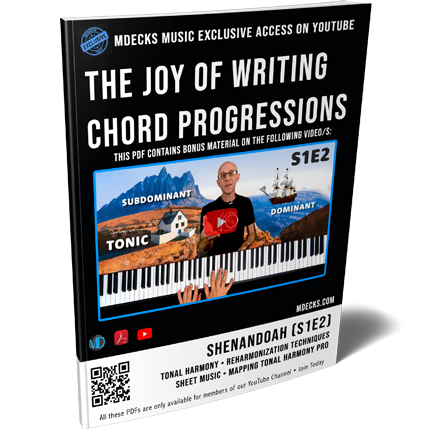
The Joy Of Writing Chord Progressions S1E2
A step-by-step arrangement tutorial reharmonizing Shenandoah that teaches chord substitutions, bass-line techniques, and how to use the Map and Tonal Harmony Pro to craft richer progressions.
Lesson Guide
Overview
This lesson uses Mapping Tonal Harmony Pro to reharmonize Shenandoah, beginning with its original progression in Eb major: Eb, Bb, Ab, and Cm, functioning as I, V, IV, and vi. The progression relies heavily on the plagal cadence, with a IV–V–I path and authentic cadence appearing only at the end. The reharmonization increases harmonic-rhythm density while using regional substitutions, inversions, secondary dominants, subVs, pedal points, and carefully designed bass movement. Melody notes and complete chordscales guide the chord choices, including the treatment of Ab as a Lydian IV chord. The lesson also explores the ambiguous iii chord, related ii–V paths, line clichés, and target-based planning. Learners can use these techniques to preserve effective bass lines, travel between harmonic regions, and develop a reharmonization either from chord functions or from a bass line.
What You'll Learn
- Identify the original Eb-major chords as I, V, IV, and vi and distinguish its plagal motion from the final authentic cadence.
- Use inversions, stepwise bass movement, descending perfect-fifth root motion, and pedal points to shape a reharmonized bass line.
- Increase the progression from one chord per measure to two or four chords per measure while maintaining a consistent harmonic-rhythm density.
- Check proposed substitutions and secondary dominants against the melody and the complete chordscale.
- Apply regional substitution, the I–iii–vi path, V7/vi, a related ii, and target-based planning in a reharmonization.
Key Concepts
Harmonic regions and substitutions
The map groups I with vi in the tonic region, IV with ii in the subdominant region, and V with viio in the dominant region. Chords within the same region share many qualities and can substitute for one another. In Shenandoah, Cm adds a different color without leaving the tonic region, while iim7 can substitute for IV. Because the original progression does not use a dominant chord before its final V, the tonic is not strongly established through the song, allowing the reharmonization to travel more freely between regions.
Bass movement, inversions, and pedal points
The lesson presents descending perfect-fifth motion and stepwise motion in either direction as the most effective bass movements. Eb/G places I in first inversion and approaches Ab chromatically from below. Cm/Bb uses third inversion of vi to create a descending stepwise bass line. Abmaj7–Bb7/Ab–Eb/G creates a pedal-like bass line: the Ab beneath Bb7/Ab acts as a subdominant pedal point, moving away from IV without actually leaving it. A pedal point anchors the listener while the harmony travels elsewhere on the map.
Harmonic-rhythm density and interpolation
Because the song is slow, its harmonic rhythm can expand from one chord per measure to two or even four. Once two chords per measure are established, the lesson recommends maintaining that density to avoid unjustified holes. At four chords per measure, first-inversion I can approach IV, and iim7 can occupy the fourth beat as a substitute for IV. Interpolated chords embellish an existing bass line without eliminating it.
Melody-aware chordscale choices
Every reharmonization choice must be checked against the melody. The attempted V7/IV technique that works in the Amazing Grace comparison does not work in measure 2 of Shenandoah. The Db in Eb7 suggests pairing Ab with Ab Ionian, but the melody contains D natural, identified as the #11 of the default Lydian scale for IV. The Ab harmony is therefore treated as Abmaj7(9, #11, 13), a Lydian Ab chord. The lesson emphasizes considering the entire chordscale rather than the chord alone.
The iii–vi region and secondary dominants
The iii chord is presented as ambiguous: it occupies its own island between the dominant and tonic regions, can serve tonic or dominant function, and works well before vi. The iii–vi progression produces descending perfect-fifth root motion, and I–iii–vi can reharmonize I. G7, V7/vi, can replace iii and tonicize vi. When Bb is the melody note, it functions as the minor third of Gm but as the #9 of G7, supporting consideration of a dominant replacement. Dm7b5 can be interpolated as the related ii.
Bass-first and target-based development
A reharmonization need not be written sequentially, measure by measure. The lesson proposes working backward from harmonic targets or writing the bass line first and then finding functions that fit it. It also introduces a line cliché: a usually chromatic inner voice moving stepwise up or down. The I and IV chords have augmented versions available, allowing an augmented harmony to support this kind of inner movement.
Musical Examples
Original progression and ending tag
The original Shenandoah progression is in Eb major and uses Eb, Bb, Ab, and Cm as I, V, IV, and vi. It relies heavily on the plagal cadence. Only the final chords contain a IV–V–I path ending with an authentic cadence, after which V returns to IVmaj7 to create an ending tag. Bouncing back to IV can extend an ending in this way.
Opening reharmonization
The repeated Eb in measure 2 becomes Eb/G, placing I in first inversion and approaching the measure-3 Ab chromatically from below. IV moves away from the opening I to produce Eb–Ab–Eb/G, and Cm supplies tonic-region color in the second measure.
Four-chord expansion and descending bass
At four chords per measure, first-inversion I appears on beat 2 of measure 1 to approach IV, while iim7 substitutes for IV on beat 4. Cm/Bb then places vi in third inversion to create a descending stepwise bass line. Changing Ab to Abmaj7 reveals that IVmaj7 contains vi inside it, and the descending bass changes the function of vi into IVmaj7.
Measure 4 and V7/vi
Measure 4 applies the earlier techniques with Eb/G–Gm–Cm7–Cm7/Bb resolving to Abmaj7. G7 can replace the iii chord as V7/vi. At the end of measure 5, G7 tonicizes vi, and Dm7b5 can be interpolated as its related ii. Playing Dm7b5 in second inversion replaces a tritone bass movement with a pedal point.
Augmented-IV line cliché
An advanced passage uses Abmaj7–Ab+maj7–Dm7b5/Ab–G7#9–Cm7. The Ab augmented chord creates the inner line Eb–E–F, providing smooth motion into Dm7b5.
Also in This Lesson
Continue Learning
The Mapping Tonal Harmony PDF version complements this lesson with multi-layered harmonic maps, Roman numerals, chord-scales, arrows and brackets, and analyzed examples for studying reharmonization choices. Its interactive diagrams and notation support focused analysis and practice planning, although the PDF contains no audio.

Related Lessons