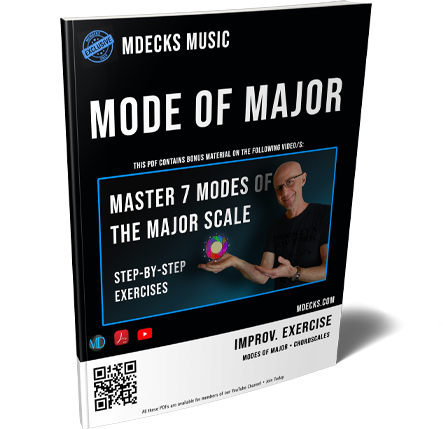
Modes of Major
A focused practice lesson that teaches the seven modes of the major scale, their chord-scale pairings, and targeted exercises to internalize them in every key.
Lesson Guide
Overview
This lesson presents the major scale, also called the Ionian scale, as a seven-note collection with the intervals 1, 2, 3, 4, 5, 6, and 7 above the root. Its whole- and half-step formula is Whole–Whole–Half, Whole–Whole–Whole–Half. Because the scale is not symmetric, it yields seven related modes. The lesson develops a chordscale perspective by pairing each mode with a suitable chord and classifying scale notes as chord-tones or tensions. The central pairing is Ionian with a major 7th chord: 1, 3, 5, and 7 are chord-tones, while 9, 11, and 13 are tensions. Practice focuses on chord-tones and includes a Lydian broken-arpeggio challenge in 7/8. These exercises support memorization of the major-scale modes, facility under the fingers, and the use of chordscales in improvisation and composition.
What You'll Learn
- Identify the major scale as the Ionian scale and name its seven natural intervals.
- State the major scale formula as Whole–Whole–Half, Whole–Whole–Whole–Half.
- Name the seven related modes and their usual mode numbers.
- Pair Ionian with a major 7th chord and distinguish its chord-tones from its tensions.
- Practice the Lydian and major 7th broken arpeggio in 7/8 using a 2 + 2 + 3 eighth-note pattern at slow tempos.
Key Concepts
Ionian paired with major 7th
Ionian is the major scale and contains the natural intervals 1, 2, 3, 4, 5, 6, and 7. Pairing Ionian with a major 7th chord turns it into a chordscale and permits its notes to be classified by their relationship to the chord. Degrees 1, 3, 5, and 7 are chord-tones because they belong to the chord; 9, 11, and 13 are tensions. This lesson focuses only on the chord-tones. The chordscale perspective is important for improvisation and composition.
Musical Examples
Major-scale mode and chord pairings
The demonstrated pairings are Ionian with a major 7th chord, Mixolydian with a dominant 7th chord, Dorian with a minor 7th chord, Aeolian with a minor 7th chord, Phrygian with a minor 7th chord, Locrian with a minor 7 flat 5 chord, and Lydian with a major 7th chord.
Lydian major 7th broken arpeggio in 7/8
The rhythmic-training challenge uses a broken arpeggio for Lydian paired with a major 7th chord. It begins on the 3rd of the chord and requires thinking of an extended maj7#11 chord to the 13th while handling 7/8. At slow tempos, count the eighth notes as 2 + 2 + 3. This counting perspective is intended to help establish the groove so it can be felt at faster tempos without counting.
Also in This Lesson
Continue Learning
Jazz Scales and Modes for Improvisation Vol.2 extends mode-focused practice into the Melodic Minor family. Its interactive PDF includes step-by-step lessons, practical application notes, call-and-response practice in all keys, warm-ups, and circle-of-fifths transformation drills, making it a relevant next resource for learners applying scales and modes to improvisation.
Related Lessons