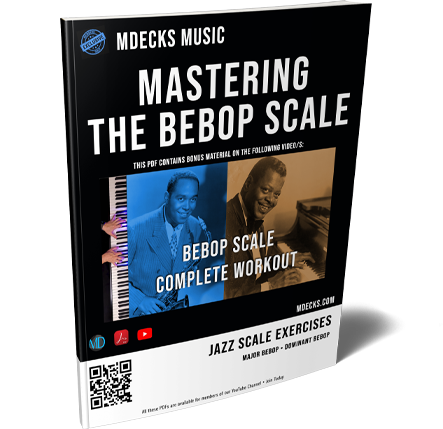
Mastering The Bebop Scale
Learn how major and dominant Bebop (Bbop) scales outline chord tones and practical exercises to apply them over C6 and dominant harmony.
Lesson Guide
Overview
This lesson focuses on the major bebop and dominant bebop scales as 8-note scales that place chord tones on every other scale note. The major bebop scale adds a b6 to the major scale—a passing tone between the 5th and 6th degrees—so its strong beats can outline a C6 chord across successive measures. The dominant bebop scale adds the maj7 to the mixolydian scale and outlines a dominant 7th chord. Practice begins by playing each scale upward and downward, including 16th-note exercises and major-bebop patterns that start on different chord tones. The lesson then develops more angular lines by adding upbeat leaps to non-chord tones, arranging step-skip patterns, and preserving chord-tone placement. An advanced dominant-bebop example inserts an escape tone and omits a note to recover the resulting rhythmic shift.
What You'll Learn
- Build the major bebop scale by adding the b6 to the major scale.
- Build the dominant bebop scale by adding the maj7 to the mixolydian scale.
- Play the scales upward and downward, including exercises using 16th notes.
- Practice the major bebop scale from the 3rd, 5th, and 6th to begin lines on different scale degrees.
- Create bebop lines with upbeat leaps while preserving chord-tone placement.
- Practice and master generated bebop lines.
Key Concepts
Eight-note scales and chord-tone placement
Adding a passing tone creates an 8-note scale that fits inside an even number of beats. In the bebop scales discussed, chord tones occupy every other scale note, so every two notes returns to a chord tone. In the demonstrated major-bebop example, strong beats produce the same C6 chord in both measures; all 16th notes can also outline C6 across the measure.
Major bebop scale
The major bebop scale is a major scale with a passing tone between the 5th and 6th degrees. In the stated construction, adding the b6 to the major scale creates this 8-note scale. Starting it on any chord tone still outlines the same C6 chord in the demonstrated example.
Dominant bebop scale
For dominant chords, the starting scale is mixolydian, identified as the 5th mode of the major scale. Adding the maj7 creates the dominant bebop scale, which outlines a dominant 7th chord. The same practice steps used for the major bebop scale are then applied to this scale.
Starting lines on different chord tones
The major bebop scale is practiced upward and downward from the 3rd and also from the 5th and 6th. These starting points teach how to begin lines on different scale degrees while retaining the demonstrated C6 outline.
Leaps and step-skip patterns
A more angular line can begin with the bebop scale and add an upbeat leap to a non-chord tone from the scale. The stated pattern-building trick uses an even number of -1s or 1s and inserts an odd number in the opposite direction. Lines based on this concept work when started on any chord tone.
Displacement and recovery
In the advanced example, inserting the escape tone A into a descending dominant-bebop line displaces E by an eighth note and shifts the rest of the line. Omitting one note recovers the shift while conserving the bebop principle through the combination of inserted leap tones and an omitted note.
Musical Examples
C major scale over C6
When the C major scale is played in eighth notes, its strong-beat notes are C, E, G, B, D, F, A, and C. The first measure outlines Cmaj7, while the extended second measure outlines Dm7, which does not work great over C6 or Cmaj7.
C major bebop scale over C6
Adding the b6 to the major scale creates the major bebop scale. In the demonstration, its strong beats produce a C6 chord in the first measure and the same C6 chord in the second measure.
Ascending and descending scale practice
The first exercise plays the scale upward and then downward. Two additional exercises use 16th notes. Further exercises begin the scale on the 3rd, 5th, and 6th.
Changing the size of an upbeat leap
One practiced line has a step-skip pattern made of -1s with a single 3. Changing the 3 to a 5 makes the leap skip to the next non-chord tone, E.
Inserted-leap patterns
The pattern (-1,-1,-1,-1,3,-1,-1,-1,-1,-1) retains the stated rules and creates another bebop line. The pattern (1,1,1,1,-3,1,1,1,1,1) is presented as a line that works on dominant chords.
Escape tone in descending dominant bebop
The advanced example inserts the escape tone A into a regular descending dominant-bebop line. Because this displaces E by an eighth note, one note is omitted to recover the shift. The example omits C because it is described as a non-chord tone and a really bad tension on G7.
Also in This Lesson
Continue Learning
Jazz Scales and Modes for Improvisation Vol.2 extends scale and mode practice through lessons on the Melodic Minor family, practical application notes, guided call-and-response workouts in all keys, warm-ups, and circle-of-fifths transformation drills. Its practice-first interactive PDF format complements this lesson’s emphasis on mastering scales and applying them to improvisational lines.
Related Lessons