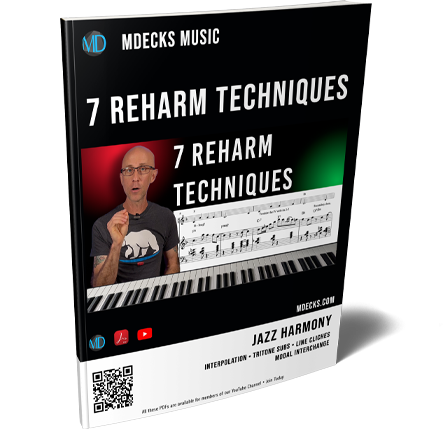
7 Reharm Techniques
Learn seven practical reharmonization techniques applied to a Jingle Bells lead sheet to make simple progressions sound more interesting.
Lesson Guide
Overview
This lesson guide presents a functional approach to reharmonizing a progression built from I, ii, IV, V, and several secondary dominants. The central question is where a harmonic path starts and where it is intended to go. From there, the guide develops six techniques: targeting diatonic chords with secondary dominants, interpolating related ii chords, substituting chords from the same harmonic region, using tritone substitutions, creating a line cliche over an extended major chord, and connecting IV to I through the gospel/blues path involving #IVo7. Examples show how these ideas can add movement and color, strengthen the arrival of a target, or provide alternative routes between existing chords. The guide also considers dominant tensions for major and minor targets and several possible interpolations between consecutive I chords.
What You'll Learn
- Identify tonic, subdominant, and dominant regions and represent chord functions with roman numerals.
- Interpolate the V of a target diatonic chord and select the stated dominant tensions according to whether the target is minor or major.
- Place a related ii chord before a secondary dominant or a diatonic V chord.
- Substitute chords within the same harmonic region and revise the preceding dominant to target the new chord.
- Define a tritone substitution and identify Eb7 as the tritone-substitution option for A7.
- Apply the demonstrated line-cliche and IV-to-#IVo7-to-I reharmonization ideas to the relevant passages.
Key Concepts
Use a secondary dominant to target a diatonic chord.
Secondary dominants target diatonic chords by interpolating the V of the intended target. In measures 12–13, the original IV-to-II change can be expanded by adding D7, functioning as V7/II, before the II chord. This adds movement and color and makes the target more inevitable. When the target is minor, the dominant should contain b9, #9, or b13; measure 12 therefore uses D7#9. When the target is major, the dominant should use natural tensions and #11, as demonstrated in measure 3 when targeting IV. Natural tensions are not explicitly expressed in the chord symbol.
the use of ii interpolations
A related ii chord can be interpolated before a dominant, whether that dominant is secondary or not, to make the path of tension and release more interesting and effective. This approach can also precede a diatonic V already present in an arrangement. In the worked passage, Am7b5 is interpolated as the related ii of D7.
substituting chords out with other chords within the same region
Chords within the same harmonic region can substitute for one another; the II and IV chords are described as interchangeable. In measure 21, the IV chord is replaced by ii, another chord from the subdominant region. Because the passage no longer targets Bb, the F7 in measure 20 can then be replaced by the V of the new ii chord. A7 is used to target the new D7.
tritone substitutions
A tritone substitution is a dominant chord rooted a tritone away from the original dominant. A7 is initially viewed as the V of the V of ii, while also being identified as V/vi; functions described as tertiary can be reduced to secondary functions. As a teaching example, Eb7 is the tritone substitution for A7.
the use of line cliches on major chords that last for several beats
The technique is demonstrated in measure 25, where two measures of F major are turned into a line cliche by raising and lowering the 5th.
the gospel/blues path that goes through the #IVo7
For a harmonic path beginning on IV and ending on I, the gospel/blues path can pass through #IVo7. The #IVo7 can also be understood as viio7/V. Measures 29–32 provide the setting: the passage begins on IV and contains a plagal cadence followed by a perfect authentic cadence.
Musical Examples
Measures 12–13: targeting II
The original passage moves from IV to II. D7 can be inserted as V7/II to target the II chord, and measure 12 uses D7#9 because the target is minor.
Measure 21: substitution within the subdominant region
The original IV chord is replaced by ii. Once Bb is no longer the target, the preceding F7 can be replaced, and A7 is used to target D7.
Related ii before D7
Am7b5 is interpolated as the related ii of D7, extending the motion into the dominant.
Measure 25: F-major line cliche
Two measures of F major are reshaped into a line cliche by raising and lowering the 5th.
Measures 29–32: gospel/blues route
The original passage starts on IV and includes a plagal cadence followed by a perfect authentic cadence. The IV-to-I path can be reharmonized through #IVo7, understood as viio7/V.
Measure 32: options between two I chords
One phrase ends on I and the next begins on I. Teaching options for the space between them are C7 as V, Gb7 as subV7, or the subtler modal-interchange option Gbmaj7 as bIImaj7.
Also in This Lesson
Continue Learning
The Art of Reharmonization directly supports this lesson’s focus on functional analysis, substitutions, advanced dominants, modal interchange, and practical song reharmonization. Its step-by-step curriculum includes a downloadable interactive PDF, paperback, video demonstrations, guided lessons, lesson maps, and analyses for intermediate-to-advanced arrangers, composers, and performers.

Related Lessons