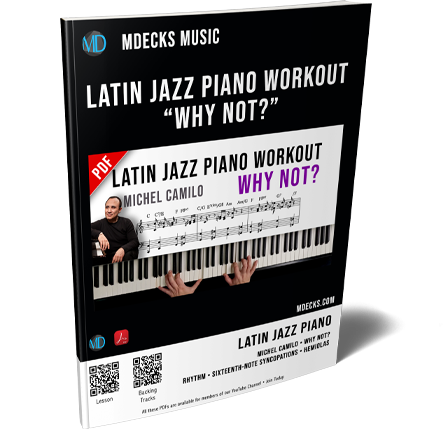
Latin Jazz Piano Workout - Why Not
A focused Latin-Jazz piano workout of rhythmic drills and progressive tempo tracks to master the 16th-note upbeats in Michelle Camilo’s “Why Not.”
Lesson Guide
Overview
This lesson develops the rhythmic control needed to play the head of “Why Not?” by Michel Camilo. Because the stated main challenge is playing the sixteenth-note upbeats, the drills begin slowly and progressively address accent placement, contrasting rhythmic perspectives, dotted-eighth hemiola, switches between sixteenth-note and eighth-note upbeats, and variations between both hands. A central principle is that the way a player hears a rhythm changes what the player feels while playing it. The work therefore combines precise placement on the rhythmic grid with the ability to hear patterns from different perspectives. The final drill removes every left-hand downbeat from its last measure, requiring a strong internal bodily sense of the downbeat. Slow, medium, and fast drill tracks support progressive practice before applying these skills to the tune.
What You'll Learn
- Play the drills progressively using slow, medium, and fast tempo versions.
- Switch at will between the “Um–Pa–Pa” and “Pa–Um–Pa” rhythmic perspectives.
- Hear, understand, and play the dotted-eighth hemiola first in 3/4 and then in 4/4.
- Switch precisely between sixteenth-note upbeats and eighth-note upbeats.
- Maintain an internal sense of the downbeat while playing rhythmic variations in both hands.
- Apply the rhythmic preparation to the head of “Why Not?”
Key Concepts
Drills Step-by-step. Drill 1: playing 16th notes upbeats
The backing tracks provide slow, medium, and fast versions of each drill so the exercise can be built progressively.
Drill 2. Placing the accent on the two sixteenth-notes after the bass
This accent placement establishes the “Um–Pa–Pa” perspective. The next two drills practice switching between that perspective and “Pa–Um–Pa.” In the latter, the current chord is anticipated by the previous sixteenth-note. Starting with the last sixteenth-note anticipating the first chord of the progression is suggested as a way to organize the chords correctly.
Drill 3: work on the dotted-eighth hemiola
The work starts in 3/4 because the dotted-eighth hemiola repeats every three beats, making it easier to hear, understand, and play there. It is then taken into 4/4, where the exercise is described as effectively playing four over three. The pattern is practiced over the bass line and then against the left-hand chords.
Drill 4: practicing the switch between sixteenth-note upbeats and eighth-note upbeats
Each measure of this drill is different. Measure one uses sixteenth-note upbeats except for a final eighth-note upbeat; measure two changes the referenced upbeat to a sixteenth note; measure three returns to the eighth-note upbeat; and the final measure uses all sixteenth-note upbeats. Precise control of this rhythmic grid is essential.
Drill 5: play rhythmic variations in both hands
This is the last drill before the song. In its final measure, the left hand plays no downbeats, so the player must keep a strong internal sense of the downbeat in the body. The lesson presents that internal pulse as the only way to play the drill correctly.
Musical Examples
The head of “Why Not?”
After the drills, the lesson proceeds to the head of Michel Camilo’s “Why Not?” The main stated challenge in the song is playing the sixteenth-note upbeats.
4/4 dotted-eighth hemiola exercise
In this exercise, the left hand plays two beats of F followed by two beats of C7. A specified sixteenth-note must land on the second sixteenth rather than being played like an eighth note.
Anticipated-chord drill
The “Pa–Um–Pa” drill uses the same progression as the preceding drill, but the chords are anticipated by the previous sixteenth-note.
Also in This Lesson
Continue Learning
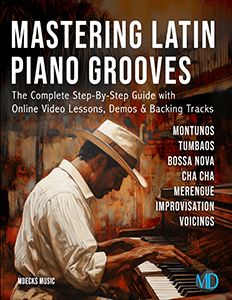
Mastering Latin Piano Grooves is relevant because it develops practical Latin groove skills through step-by-step exercises, video demonstrations, and call-and-response backing tracks. Its coverage of montuno patterns, Bossa Nova comping, Cha-Cha, Merengue, clave, tumbao concepts, and Latin comping voicings offers broader groove-focused practice for an intermediate pianist.
Related Lessons