Latin Jazz Piano Improv with Quartal Voicings
Apply quartal left‑hand voicings and upbeat Latin comping to improvise over modulating ii‑V‑I progressions.
Lesson Guide
Overview
This lesson develops a coordinated approach to quartal left-hand voicings, upbeat-based accompaniment rhythms, and improvisational source material. The progression consists of 2-5-1’s that modulate by half step down. The voicing approach places ambiguous quartal sounds over the bass player’s 2-5-1, producing combinations of chord-tones and tensions that include altered colors on the V chord. Rhythm work begins with a two-hand pattern, advances from two chords to the entire groove, and emphasizes looping the material until it feels comfortable. For improvisation, the annotated score identifies the use of different chord-scales and approach tones. A practical first step is to transpose the first four measures through all the song’s 2-5-1’s before playing the entire solo with backing tracks at different tempos.
What You'll Learn
- Play the demonstrated quartal left-hand voicings over a 2-5-1.
- Identify the chord-tones and tensions created by the quartal voicings on the ii, V, and I chords.
- Coordinate an accompaniment rhythm made almost entirely of up-beats with the right-hand practice pattern.
- Loop the rhythmic material until the groove feels comfortable against the accompaniment.
- Transpose the first four measures through all the different 2-5-1’s in the song.
- Use the annotated score to examine the chord-scales and approach tones used in the improvisational lines.
Key Concepts
the voicings
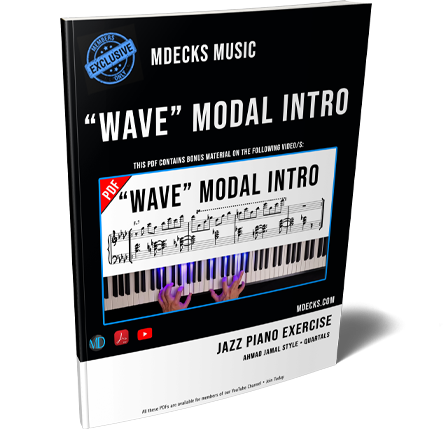
The left hand uses quartal voicings over a 2-5-1. In the demonstrated example, F47 is I47 over Fm7. Moving a minor 3rd reaches Ab47 for Bb7, identified as bVII47 over the V chord. For Ebmaj7, the voicing can move up or down a half step, producing either III47, G47, or #IV47, A47. The ii voicing contains the root, b7, and 11th; the V voicing contains the b7, #9, and b13; III47 over I contains the 3rd, 6th, and 9th; and #IV47 contains the #11, maj7, and 3rd, making the chord maj7#11. The technique draws power from the ambiguity of the quartal sound over the bass player’s 2-5-1.
the rhythms
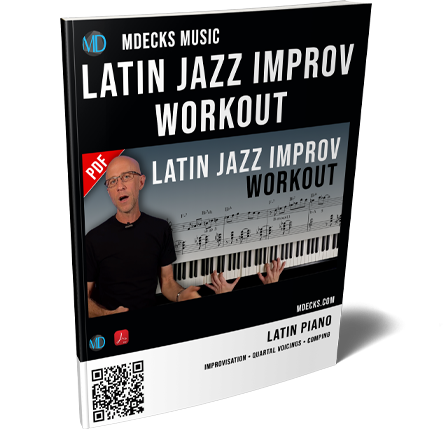
The left-hand accompaniment rhythm is tricky because it is almost entirely made of up-beats. Practice begins with both hands and a right-hand pattern of C F Bb C Bb F with the rhythm e e q e e q. Step one uses only two chords, and Variation 1 changes the player’s perspective of the comping pattern against the right hand. Repeat the pattern in a loop until it can be felt like playing congas. Then add the entire groove, and do not advance until it feels comfortable against the accompaniment.
the source material or chord-scales to consider when improvising your lines
The improvisational lines use different chord-scales and approach tones, and the score is annotated to show where the lines come from. A suggested first step is to take the first four measures and play them in all the different 2-5-1’s in the song. After completing that transposition work, play the entire solo and use the backing tracks at different tempos.
Musical Examples
Quartal voicings over Fm7–Bb7–Ebmaj7
The demonstration uses F47 over Fm7, Ab47 over Bb7, and either G47 or A47 over Ebmaj7. These are identified respectively as I47 on ii, bVII47 on V, and either III47 or #IV47 on I.
Chord-tones and tensions in the voicings
The ii voicing supplies the root, b7, and 11th. The altered V sound supplies the b7, #9, and b13. On I, III47 supplies the 3rd, 6th, and 9th, while #IV47 supplies the #11, maj7, and 3rd.
Two-hand rhythmic preparation
The right hand plays C F Bb C Bb F with the rhythm e e q e e q while the accompaniment pattern is practiced first with two chords and then with the entire groove.
Four-measure improvisation study
Take the first four measures and play them in every different 2-5-1 in the song. Once this is complete, proceed to the entire solo.
Also in This Lesson
Continue Learning
Mastering Latin Piano Grooves complements this lesson’s focus on rhythmic feel, left-hand comping, jazz harmony, and coordinated practice. Its step-by-step work on montuno, Bossa Nova, Cha-Cha, Merengue, clave, tumbao, and Latin comping voicings provides additional groove study, while its video demonstrations and call-and-response backing tracks support real-time practice at the piano.
Related Lessons