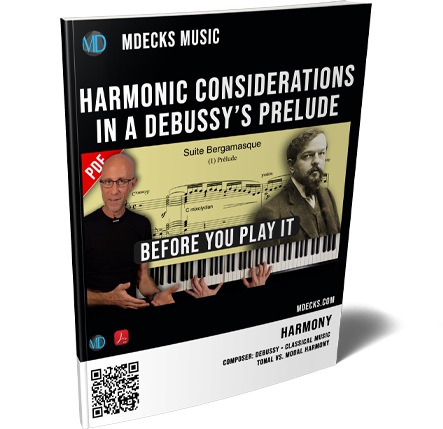
Debussy Prelude (Suite bergamasque) — Harmonic Considerations
Detailed harmonic analysis and practical voicings for Debussy's Prelude from Suite bergamasque, with an annotated PDF.
Lesson Guide
Overview
This lesson examines the Prelude from Debussy’s Suite bergamasque by tracing movement between tonal and modal colors and considering how those harmonic implications shape sound, phrasing, and musical breathing. The opening establishes F major through a C7sus4 sonority above tonic F, followed by I, IV, iii, and vi, while added 9ths enrich the tonic and IV chords. The same motif later appears in different harmonic contexts, including a 2-5 of IV, altered dominant motion, and a 2-5 of V. Other passages demonstrate modal parallel motion, lydian harmonization, A Aeolian harmony, tonal implications, major-third modulations, and whole-tone relationships. The practical goal is to hear each passage not merely as a succession of chord symbols, but as a shifting relationship among tonal function, modal color, chord-scale resources, and cadential treatment.
What You'll Learn
- Analyze the opening as V7sus4 to I, followed by IV, iii, and vi in F major.
- Explain how tonic F functions as a pedal point beneath the opening C7sus4.
- Identify added-9th sonorities and the Gm upper structure that supplies D over C7sus4.
- Compare the motif’s different tonal and modal harmonic contexts.
- Recognize lydian harmonization, A Aeolian harmony, major-third modulation, and whole-tone relationships in the cited passages.
- Describe how parallel 5ths and octaves contribute to the modal sound of the piece example.
Key Concepts
Tonal grounding through a suspended dominant
The opening progression is V7sus4 to I, followed by IV, iii, and vi, grounding the music in F major. The first chord is C7sus4, with a voicing described as Gm over C over an F pedal point. Because F is both the suspended 4th of C7sus4 and the tonic in the bass, the sonority can be heard as V7sus4 with a tonic pedal point. It also has traits of a double appoggiatura, Bb/F resolving to F, while retaining its V7sus4 function.
Extensions and upper structures
The initial line is based on C mixolydian. As a teaching example, placing a Gm upper structure over C7sus4 supplies the 9th, D. Extending chords to the 9th is described as a typical resource in Debussy’s music. At the tonic arrival, the chord is Fadd9 with G on top, and the IV chord, Bbmaj7, is also add9.
One motif in different harmonic contexts
Debussy places the same motif in different harmonic contexts. One presentation uses I–IV–iii–vi, while another functions as a 2-5 of IV. In the recapitulation, F+ to Bb is analyzed as V+/IV to IV, followed by F7 to Dm, analyzed as V7/IV to vi. The vi chord changes the expected tonal target Bbmaj7/D into the modal target F7 to Dm. The final iteration moves from Dm to Gm, or vi–ii, and Dm to G7 then functions as a 2-5 of V, targeting C7 in the coda.
Tonal cadences treated modally
Debussy alternates between tonal and modal harmony and treats many tonal cadences with a modal approach. A tonal deceptive cadence is V to vi; a teaching example extends that idea from 2-5-1 to 2-5-6. Where tonal harmony may use contrary motion because C to Dm creates many parallel 5ths and octaves, Debussy embraces those parallels, creating a modal sound.
Chord-scale parallel motion and lydian color
A modal approach can use the current chord-scale to create parallel motion with chords from that mode. The IV chord is reached through a 2-5 of IV and treated as lydian. Debussy harmonizes the melody notes with triads found in lydian. At the end of the run, however, F+ targets Bb again; this F+ is identified as the borrowed tonal chord V+/IV. A teaching comparison notes that using the regular chord from lydian removes the described magic effect.
Aeolian, tonal implication, and modulation
The B section moves fully into A Aeolian, using Bm7b5 as iim7b5 and the cadential minor V, Em. Before modulating, the music begins to imply tonality. Because A Aeolian has the same notes as C major, the distinction depends on cadential treatment. The end of the section can be heard as 6-2-5-1: Am to Dm to G7 to C6. Sudden modulations by major 3rds are another identified trait, including movement from C to E through G7–Cmaj7 and then B7–Emaj7.
Musical Examples
Opening sonority and resolution
Hear C7sus4 above tonic F as both a suspended dominant with a tonic pedal point and a sonority with double-appoggiatura traits. Follow its resolution to Fadd9, then Bbmaj7(add9), iii, and vi.
Gm upper structure over C7sus4
As a demonstration, place Gm over C7sus4 to supply the 9th, D, and relate the line to C mixolydian.
Recapitulation targets
Compare F+–Bb, analyzed as V+/IV–IV, with F7–Dm, analyzed as V7/IV–vi. The second motion replaces the expected tonal target Bbmaj7/D with the modal target Dm.
Lydian harmonization of the IV chord
After the 2-5 of IV, follow the harmonization of melody notes with triads found in lydian, then hear F+ return as V+/IV targeting Bb.
A Aeolian becoming tonally directed
Contrast the use of Bm7b5 and Em in A Aeolian with the later 6-2-5-1 reading: Am–Dm–G7–C6.
Major-third modulation and return
Trace G7–Cmaj7 followed by B7–Emaj7, then consider the ambiguous return passage and the later transformation of B7 into F#m7b5 and F#7b5.
Also in This Lesson
Continue Learning
The Art of Reharmonization provides a structured continuation for intermediate-to-advanced musicians studying functional analysis, substitutions, advanced dominants, modal interchange, and practical song applications. Its lessons, analyses, interactive PDF, paperback, and video demonstrations align with the tonal, modal, dominant, and chord-substitution ideas explored here.

Related Lessons