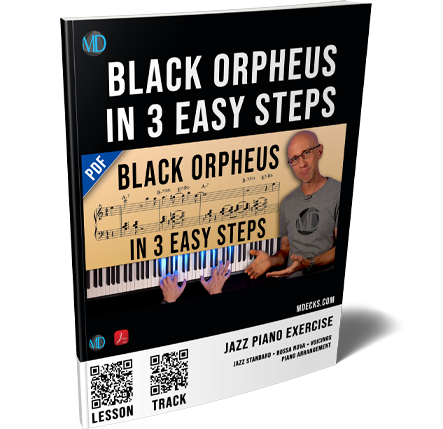
Black Orpheus — Jazz Piano Lesson: 3 Steps to Turn a Lead Sheet into an Arrangement
Step-by-step lesson showing how to turn the Black Orpheus lead sheet into a full jazz piano arrangement.
Lesson Guide
Overview
This lesson uses Black Orpheus to demonstrate a three-step approach to learning a song from a lead sheet. First, learn rootless voicings in the left hand, using voice-leading for smooth movement while also practicing occasional position shifts. Play the voicings with a backing track on the downbeats before adding rhythm. Second, add the melody in the right hand while keeping the comping light and rhythmically simple. Rather than playing the Bossa nova comping pattern constantly, use simple rhythms based on it and place harmony in spaces in the melody. Third, split the harmonic layer between both hands by moving some chord notes to the right hand while retaining the melody and adding simple improvised variations. This allows the left hand to use 1-7 shell voicings and more of the lower register.
What You'll Learn
- Play the demonstrated rootless left-hand voicings with a backing track, first on the downbeats and then with added rhythm.
- Use voice-leading for smoother movement between voicings and practice shifting positions when needed.
- Add the melody while keeping comping light and using simple rhythms based on the Bossa nova pattern.
- Use spaces in the melody to provide harmonic context.
- Split harmony between both hands while playing the melody and improvising simple variations.
Key Concepts
1. Learn the left hand voicings and practice them with a backing track…
Begin with rootless voicings in the left hand. Practice the A minor 2-5-1 until it feels easy, then work through the other demonstrated progressions. Use voice-leading to make movement between voicings smoother, but also practice occasional position shifts because always following voice-leading will usually move the voicings very low in the register for most progressions. With the backing track, first place the voicings on the downbeats; once that can be played, add rhythm.
2. Add the melody on your right hand…
Add the melody while keeping the comping chords light and rhythmically simple. Do not play the Bossa nova comping pattern constantly beneath the melody, because this sounds bad and busy and is difficult to perform. Instead, use simple rhythms based on that pattern and place harmonic context in the spaces in the melody.
3. Then split the harmony layer between both hands, and add a few improvised variations to the melody…
To make the arrangement more interesting, split the harmonic layer between both hands. Move some chord notes to the right hand while continuing to play the melody and improvising simple variations. The left hand can then use 1-7 shell voicings and more of the lower register.
Musical Examples
Black Orpheus
Black Orpheus is used to demonstrate the complete three-step approach.
2-5-1 in A minor
The demonstrated progression is Bm7b5 to E7 to Am. Practice it until it feels easy.
2-5-1 in C major with the IV chord
The demonstrated progression is Dm7 to G7 to Cmaj7 to Fmaj7, with Fmaj7 added as the IV chord.
2-5-1 in D minor
Play Em7b5 in root position, jump to the demonstrated A7 voicing, and then play Dm7. This example practices shifting voicing positions.
Dm to Dm/C line cliché
Retain the same voicing from Dm to Dm/C and let the bass handle the change.
Am to Am/G line cliché
Use the same approach demonstrated for Dm to Dm/C: retain the voicing while the bass handles the change.
Also in This Lesson
Continue Learning
4-Note Rootless Voicings Vol.1 directly supports the lesson’s first stage by teaching essential four-note closed-position rootless voicings for jazz piano. Its key-based five-minute workouts include backing tracks, charts, demonstrations, and sheet music for focused voicing practice.

Related Lessons