Bebop Dominants Workout (Exercises 1–10) — Barry Harris Concepts for Piano
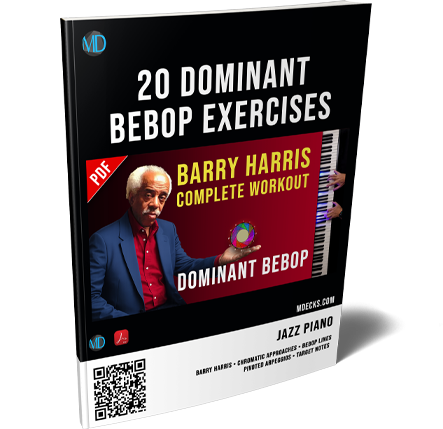
Interactive PDF workbook and practice pack of 20 bebop dominant exercises for piano, with full key and tempo support.
Lesson Guide
Overview
This lesson presents bebop improvisation as a system for understanding how dominant-chord lines are built, rather than as a collection of isolated licks. The workout begins by superimposing a related minor-seven arpeggio over a dominant chord and targeting a strong chord tone. It then develops that foundation through double chromatic approaches, pivoted arpeggios, chord-tone-based arpeggios, dominant bebop-scale connections, and chromatic trapping. The exercises move from simple arpeggio-and-enclosure combinations toward changes of direction, chromatic connections, and longer phrases. The central practice goal is to recognize each technique, combine the concepts in real time, and eventually feel the resulting lines without consciously thinking through every device. All lines in the tutorial are designed for dominant chords.
What You'll Learn
- Play a minor-seven arpeggio built on the 5th and resolve it to the dominant chord’s 3rd in every key.
- Approach the dominant chord’s 3rd with a double chromatic approach from below.
- Create a broken, angular line by moving the first note of an ascending arpeggio up an octave.
- Build four-note ascending arpeggios from each chord tone of C7 and connect them to the 5th through the C dominant bebop scale.
- Identify and apply chromatic trapping, including approaches from above and below.
- Identify the techniques in a pattern before playing it and combine them to create new lines.
Key Concepts
Exercise 1 — Minor-Seven Arpeggio to the Dominant 3rd
Play the minor-seven arpeggio built on the 5th and then target the 3rd of the dominant chord. Over C7, the line uses Gm7—G, B-flat, D, F—and resolves to E. Gm7 is described as C7’s related ii chord, so the line implies a complete ii–V movement while the underlying harmony remains C7. The exercise takes this formula through every key.
exercise 2 — Double Chromatic Approach from Below
Keep the Gm7 arpeggio over C7, but replace the direct resolution to E with a double chromatic approach from below. E remains the target because it is the 3rd of C7.
Exercise 3 — Pivoted Arpeggio
Transform the Exercise 1 arpeggio by moving its first note, G, one octave higher. This pivot changes the ascending arpeggio into a broken, more angular line. Exercise 4 later combines this pivoted form with the chromatic approach from Exercise 2.
Exercise 5 — Chord-Tone Arpeggios and Bebop-Scale Descent
Begin a four-note ascending arpeggio on each chord tone of C7—the root, 3rd, 5th, and 7th—using C mixolydian as the underlying chord-scale. After each arpeggio, descend through the C dominant bebop scale until reaching the 5th. Starting on the root produces 1, 3, 5, and b7; starting on the 3rd includes the 9th; starting on the 5th includes the 11th; and starting on the b7 includes the 13th. The measure containing the 11th, described as an avoid tension on dominant chords, outlines Gm7, the related ii chord.
exercise 6 — Chromatic Trapping
Add chromatic trapping by approaching a target from above and below. To trap the root C, play Db, B, C: Db approaches C from above, and B approaches it from below. The dominant bebop scale has a passing tone between the root and the b7.
Musical Examples
Gm7 resolving to C7
Over C7, play G, B-flat, D, F to outline Gm7, then resolve to E, the 3rd of C7. This superimposes the related ii chord and implies ii–V movement within the dominant chord.
Trapping the root of C7
Use Db, B, C to target the root. Db approaches C from above, while B approaches it from below.
Exercise 10 technique chain
Begin with an arpeggio from the 7th, trap the 5th to form the beginning of a pivoted arpeggio, and then approach the 3rd with a double chromatic approach from below.
Also in This Lesson
Continue Learning
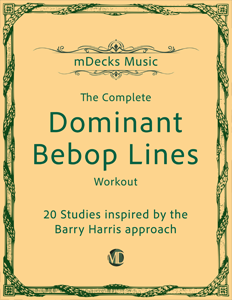
The Dominant Bebop Lines Workout (Barry Harris) directly extends this lesson with 20 original dominant bebop-line exercises. Its interactive PDF combines related ii-chord and seventh-chord arpeggios, pivoted arpeggios, double chromatic approaches, trapping figures, enclosures, and dominant bebop-scale connections, and it includes introductory guidance plus a complete video lesson.
Related Lessons