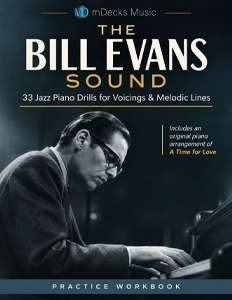
The Bill Evans Sound — Beyond Chords: Drills 5–7 (Voicings & Melodic Lines)
PDF lesson with Drills 5–7 exploring Bill Evans-style minor voicings, quartal dominants, and reharmonized melodic lines.
Lesson Guide
Overview
These three drills develop connected harmonic, melodic, and rhythmic ideas for Bill Evans-style piano lines. Drill 5 places a minor seventh chord built on the fifth in the right hand over an open minor-triad arpeggio with an added ninth, emphasizing awareness of the entire measure rather than only the notes sounding at one moment. Drill 6 applies a right-hand quartal structure built on each dominant chord’s third and a left-hand root–flat-seven shell to a sequence moving around the circle of fifths. Drill 7 brings the material into a Imaj7–V7 of IV–IVmaj7 progression, combining upper structures, melodic lines, open arpeggios, chromatic approaches, syncopation, and reharmonization. The practical goal is to understand how each structure is built, use that understanding to create variations, and develop melodic contours that follow the harmony rather than merely memorizing the demonstrated notes.
What You'll Learn
- Build the Drill 5 upper structure and left-hand arpeggio for a minor seventh chord, then apply the construction to other minor seventh chords.
- Move Drill 6 right-hand quartal structures and left-hand root–flat-seven shells around the circle of fifths.
- Play the Drill 7 progression Imaj7–V7 of IV–IVmaj7, demonstrated as Dmaj7–D7–Gmaj7 in D major.
- Create a simple melodic contour that follows the harmony and harmonize it with upper structures, thirds, sixths, or notes supplied by the other hand.
- Combine open arpeggios, chromatic approaches, syncopation, melodic movement, and reharmonization while understanding what each element contributes.
Key Concepts
DRILL 5 — Minor 7th Chords: Thinking Ahead
The right hand plays a minor seventh chord built on the fifth of the underlying chord. Over Dm7, this upper structure is Am7. The left hand plays an open D minor triad with an added ninth, broken into an arpeggio; it begins on E and A, the ninth and fifth of Dm7. Because the opening notes sound more like Am7 than Dm7, the line must be understood across the entire measure rather than only through the notes sounding at a given moment. The same construction is demonstrated over Ebm7 with Bbm7 in the right hand and an open Eb minor triad with the added ninth in the left. Understanding how the voicing is built allows it to be applied to any minor seventh chord.
DRILL 6 — Dominant Chords: Quartal Upper Structures
This drill uses an extended dominant sequence moving around the circle of fifths, beginning A7, D7, G7, C7, and so on. The right hand plays a perfect quartal structure built on the third of each chord, while the left hand uses a root–flat-seven shell. The pattern does not begin on the root: over A7, the quartal structure begins on C#, while the left hand moves from G, the seventh, to A, the root. Over D7, the right hand begins on F#, the third, and the left hand moves from C, the flat seventh, to D. Once these two structures are understood, they can be moved around the circle of fifths.
DRILL 7 — Reharmonization, Melodic Lines, and Putting It All Together
The first chord progression in the series is Imaj7 followed by V7 of IV and IVmaj7, demonstrated in D major as Dmaj7–D7–Gmaj7. The right hand begins with a major triad built on the fifth—A major over Dmaj7—then adds passing notes to form a moving melodic line. The left hand begins with the open Dmaj7 arpeggio D–A–F#–C# and uses syncopation; together, the hands create continuous eighth-note movement. At D7, the left hand reuses the Drill 6 shell voicing and begins on the flat seventh. On Gmaj7, D# approaches E chromatically, moving from the sharp fifth to the sixth. The drill combines upper structures, melodic lines, open arpeggios, chromatic approaches, syncopation, and reharmonization. It closes with Ab7, using the quartal dominant voicing from Drill 6, because the pattern is about to modulate down a half step to Db major, whose dominant is Ab7.
Musical Examples
Dm7 and Ebm7 upper structures
Over Dm7, play Am7 in the right hand while the left hand outlines an open D minor triad with an added ninth. The left-hand arpeggio begins on E and A. Over Ebm7, use Bbm7 above an open Eb minor triad with the added ninth.
A7 and D7 quartal dominant patterns
Over A7, build the right-hand quartal voicing from C#, the third, while the left hand moves from G to A. Over D7, begin the quartal structure on F# and move the left hand from C to D.
Reharmonizing a static Dmaj7 passage
A two-measure Dmaj7 passage can be reharmonized by playing Gmaj7 in the first measure and returning to Dmaj7 in the second. Gmaj7 can then be approached by its dominant, D7, producing | Dmaj7 D7 | Gmaj7 |. This can be done on the fly while playing a tune.
Melodic contours through Dmaj7–D7–Gmaj7
One demonstrated line is C#–D–E–F# | D–A–G. An alternative is E–D–C#–A | G–A–G. The exact written line is not required; the aim is to create a simple contour that follows the harmony and then find ways to harmonize it.
Harmonizing the Drill 7 line
The A major triad functions as an upper structure over Dmaj7. Over D7, F# is harmonized with C, the flat seventh. On Gmaj7, D is harmonized with B a third below and doubled in the lower octave. Thirds, sixths, upper structures, and notes supplied by the other hand are available harmonization options.
Chromatic motion and modulation connector
On Gmaj7, D#–E demonstrates the sharp fifth approaching the sixth, while D#–F#–E demonstrates a trap around the sixth. The ending connection is Gmaj7 → Ab7 → Dbmaj7, with Ab7 serving as the dominant of Db major and using the quartal dominant voicing from Drill 6.
Also in This Lesson
Continue Learning
The Bill Evans Sound workbook expands this material through 33 notated piano drills covering upper structures, broken and open arpeggios, inner-voice movement, rootless voicings, line clichés, passing diminished chords, tritone substitutions, modal colors, and richer progressions. Its exercises include work through all 12 keys, and an original arrangement of A Time for Love demonstrates how the concepts can function together in a complete musical setting.