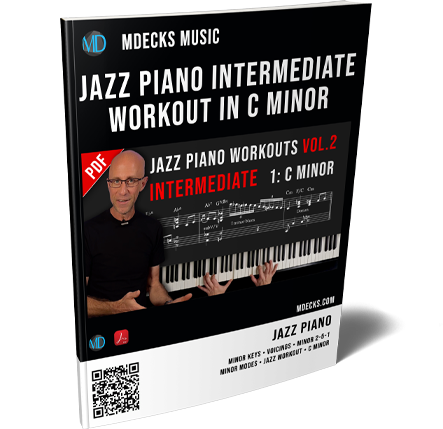
Jazz Piano Workouts Vol.2 — Lesson 1: C minor (Intermediate)
Focused four-level C minor workout that builds voicings, chord–scale fluency, and improvisation.
Lesson Guide
Overview
This workout focuses entirely on minor keys and is designed to develop musical, expressive practice rather than purely mechanical repetition. Each key is organized into four levels that simultaneously address jazz voicings, functional harmonic motion, chord-scale relationships, and ear training. Level 1 establishes essential minor-key harmony through ii–V–i motion, tonic-minor colors, secondary ii–V movement, tritone substitution, and a Dorian sound. Level 2 retains the progression while adding altered tensions and a minor-blues variation. Level 3 connects each harmony with a specified chord scale, including Locrian, Mixolydian flat 9 flat 13, Lydian flat 7, Lydian, and Dorian. Level 4 turns those materials into simple improvisational ideas. The larger goal is to map the sounds and concepts across all keys while keeping the ears—not exact rhythmic reproduction—the primary focus.
What You'll Learn
- Play the minor ii–V–i progression and distinguish C minor 6, C minor major 7, and C minor 7 as tonic-minor sounds.
- Recognize that the ii–V targeting I minor and the ii–V targeting IV minor use the same voicings, melody, and harmonic logic when transposed.
- Add the natural 9 to ii chords and combine flat 9 and sharp 9 on dominant chords without changing the underlying progression.
- Connect the specified chords with Locrian, Mixolydian flat 9 flat 13, Lydian flat 7, Lydian, and Dorian.
- Improvise simple ideas with the Level 3 chord scales while hearing the harmony and how each sound resolves.
Key Concepts
Level 1: Essential Minor-Key Harmony
Level 1 begins with D minor 7 flat 5 → G7 flat 9 → C minor. Over the tonic, a line cliché moves through C minor 6, C minor major 7, and C minor 7—three extremely important versions of the I minor chord in jazz. The progression then moves around the circle of fifths. G minor 7 flat 5 → C7 flat 9 → F minor 7 targets the IV minor chord, followed by B-flat 7 → E-flat major 7 → A-flat major 7. E-flat major is the relative major of C minor. E7 sharp 11 is interpolated as the subV of E-flat, so both B-flat 7 and E7 can target E-flat major 7. The return uses subV-to-V-to-I motion rather than a standard ii–V–i. The level also explores I minor Dorian through the I minor pentatonic scale. The ii–V progressions targeting I minor and IV minor behave in exactly the same way; the second is a transposition with the same voicings, melody, and harmonic logic.
Level 2: Tension and Blues Variations
Level 2 uses exactly the same harmonic progression as Level 1 while changing selected colors. The ii chords receive a natural 9, opening the sound without changing their harmonic function. On the dominant chords, flat 9 and sharp 9 are combined instead of using only flat 9. These altered tensions work well together in this context and create a strong, common sound when resolving to minor chords. In the final melodic run, the minor blues scale replaces the exclusive use of the I minor pentatonic scale. Here, the minor blues scale is understood as the minor pentatonic scale with an added flat-5 passing tone.
Level 3: Chord Scales
Level 3 introduces chord scales. Locrian is used on the ii minor 7 flat 5 chords; it is the seventh mode of the major scale. D Locrian contains the same notes as E-flat major, which are also the notes of C natural minor. Mixolydian flat 9 flat 13 is used on the V7 chord and the V of IV. It is the fifth mode of harmonic minor, and G Mixolydian flat 9 flat 13 contains exactly the same notes as C harmonic minor. On E7 sharp 11, a line derived from Lydian flat 7 outlines the tritone-substitution sound targeting E-flat major. A-flat major 7 uses Lydian, giving the same note collection as E-flat major and C natural minor from another harmonic perspective. The final C minor chord uses C Dorian, an extremely common I-minor sound in jazz. These related scales may share notes while organizing and hearing them from different starting points.
Level 4: Improvisation
Level 4 uses the chord scales introduced in Level 3 to improvise simple ideas over the progression. Its goal is to translate the harmonic and chord-scale concepts into musical ideas that can be used while improvising. The workout is primarily an ear-training and conceptual-training exercise rather than a reading exercise, so players are instructed not to overload their attention by reproducing every written rhythm with absolute precision. The priority is to hear the harmony clearly, recognize how each sound behaves and resolves, and map the concepts across all keys. Technical precision develops in support of that understanding.
Musical Examples
Minor ii–V–i and tonic line cliché
The Level 1 example begins D minor 7 flat 5 → G7 flat 9 → C minor. Over C minor, the line cliché passes through C minor 6, C minor major 7, and C minor 7.
Secondary ii–V to IV minor
G minor 7 flat 5 → C7 flat 9 → F minor 7 targets the IV minor chord. This ii–V behaves in exactly the same way as the ii–V targeting I minor and retains the same voicings, melody, and harmonic logic when transposed.
Two approaches to E-flat major 7
Within the circle-of-fifths motion B-flat 7 → E-flat major 7 → A-flat major 7, E7 sharp 11 may be interpolated before E-flat major 7 as its subV. Both B-flat 7 and E7 can therefore target E-flat major 7.
Same notes from different starting points
D Locrian, E-flat major, and C natural minor contain the same notes. A-flat Lydian also gives the same collection as E-flat major and C natural minor, heard from another harmonic perspective.
Harmonic-minor dominant scale
G Mixolydian flat 9 flat 13 contains exactly the same notes as C harmonic minor. This scale is used on the V7 chord and the V of IV.
Also in This Lesson
Continue Learning
Jazz Piano Workouts Int-2 directly supports this lesson’s focus on intermediate chord-scale fluency, harmonic awareness, voicings, voice-leading, dominant variations, and ear training. Its 12-week, one-key-per-week structure is suited to mapping these minor-key sounds across all keys, while the interactive PDF, video demonstrations, and chords → chord-scales → improvisation practice method reinforce the lesson’s progression from harmony to chord scales and usable improvisational ideas.
Related Lessons