
Bb Minor Harmonic Map — Jazz Piano Workouts Vol.2 No.3
A focused walkthrough of a Bb minor jazz progression with a functional harmonic map and play-along workout.
Lesson Guide
Overview
This hands-on walkthrough reconstructs a harmonic progression in Bb minor by tracing its harmonic paths. After completing Lessons 1 and 2, work with the Bb circle of fifths and the supplied functional map or chord-free progression page. The lesson begins with seventh chords from the relative major, Db, then establishes the Bb-minor functional set. From there, locate resolution targets, build 2-5 paths through circle-of-fifths movement, and interpret brackets, solid arrows, dashed arrows, and broken arrows. The reconstruction includes secondary functions, 7sus4 substitution, and subV interpolations. Examples include the opening Cm7b5–F7–Bbm6, a secondary 2-5 targeting Ebm7, and an expanded path to Dbmaj7. The final task is to play the progression from the completed reconstruction.
What You'll Learn
- Identify Db as the relative major of Bb minor using the 9 o’clock position on the referenced circle.
- Derive the stated seventh-chord functional set for Bb minor from its relative major, with the lesson’s exceptions for I and V.
- Reconstruct resolving 2-5 paths by following the circle of fifths from subdominant to dominant to tonic.
- Interpret solid brackets, solid arrows, dashed arrows, and solid-to-dashed broken arrows on the functional map.
- Locate secondary functions and insert a subV between a V chord and its target.
- Play the progression from the completed harmonic reconstruction.
Key Concepts
Building the Bb-minor chord set from Db major
The lesson starts from Db, the relative major found at 9 o’clock on the referenced circle. It states that the diatonic chords for Bb minor are the same as those of the relative major except for I and V: V is dominant from harmonic minor, while I may be m6 or mmaj7 from melodic minor, or m7 from natural minor. The resulting functional set is written as iim7b5, V7, Im6, ivm7, bVII7, bIIImaj7, and bVImaj7.
Resolving 2-5 paths
A 2-5-1 moves from subdominant to dominant to tonic and follows the circle of fifths, described in the lesson as the strongest root movement in harmony. A resolving 2-5 is written with a bracket followed by an arrow: the solid bracket represents the 2-5, and the solid arrow represents the 5-to-1 resolution.
Finding targets before approach chords
The reconstruction first looks for targets marked by solid arrows. These targets are points of resolution and are usually diatonic chords. Once a target is located, its approach can be reconstructed by following the circle of fifths, including secondary 2-5 chords that are not diatonic to Bb minor.
SubV interpolation and tritone relationships
A subV interpolation changes a 2-5-target path into a 2-5-sub5-target path. The V and subV work together to target the following chord and are always a tritone apart. On the circle of fifths, tritones appear on opposite sides. A solid-to-dashed broken arrow represents two dominant chords separated by a tritone.
Reading dashed dominant motion
A dashed line denotes root movement downward by a half step. In this progression, a dashed arrow indicates a dominant chord resolving downward by a half step, while an arrow denotes a dominant chord resolving to its target.
Musical Examples
Opening 2-5-1 in Bb minor
The opening progression is Cm7b5–F7–Bbm6, demonstrating movement from subdominant to dominant to tonic.
Secondary 2-5 of IV
The IV chord is Ebm7. Its approach is Fm7b5–Bb7–Ebm7, with Fm7b5 and Bb7 identified as secondary functions rather than diatonic chords of Bb minor. Applying the same subV interpolation places E7 a tritone away from Bb.
Expanded approach to bIIImaj7
The bIIImaj7 target is Dbmaj7. Its secondary 2-5 is Ebm7–Ab7–Dbmaj7, with Ab7sus4 substituted for the regular Ab7 in the exercise. D7 is then interpolated as the subV, resolving downward by a half step to Db. The lesson labels D7 as V7/bIII and identifies Ab and D as a tritone apart.
Approach to the final target
The source identifies the last target as Im6 and then names it Bbm7. It is preceded by F7, and F7 is preceded by its subV, Gb7, shown in the secondary mini-map of F7.
Additional Bb-minor targets
The bVI chord is identified as Gbmaj7. A circled arrow indicates that the progression is still moving around the circle.
Also in This Lesson
Continue Learning
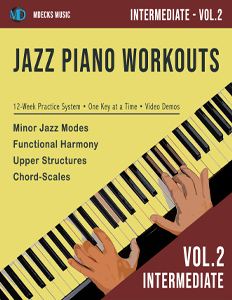
Jazz Piano Workouts Int-2 complements this lesson’s focus on one-key harmonic reconstruction. Its 12-week, one-key-per-week practice system develops harmonic awareness and chord–scale fluency through an interactive PDF, video demonstrations, ear training, dominant variations, voicings, voice-leading, and a three-pass practice method.
Related Lessons